Can You Put Creatine in a Protein Shake? Benefits & Tips
 Reading time: 7 min
Yes, you can mix creatine directly into a protein shake. There's no need to take them separately. Protein supports muscle repair, and creatine helps maintain the muscle stores behind high-intensity performance. Combine them for convenience, and stay consistent for results.
Creatine and protein can be mixed in the same shake without either one becoming less effective. They work through different mechanisms, protein supports muscle repair, creatine supports repeated high-intensity effort, so combining them is a matter of convenience rather than a special performance boost.
What happens when you mix creatine with protein?
Creatine and protein don't compete with one another in a shake. Protein provides the amino acids your body uses for muscle protein synthesis. Creatine increases muscle creatine and phosphocreatine stores, which supports energy availability during repeated high-intensity exercise. Mixing them doesn't make either one less effective.
They're complementary, not interchangeable. Protein can't replace creatine's role in short-burst energy production, and creatine can't replace adequate protein intake for recovery and growth. It's worth being clear here: the two aren't a proven "synergy" that dramatically outperforms taking either one alone.
Some research suggests that insulin, stimulated by carbohydrate and to a lesser extent protein, can increase how much creatine muscle retains during supplementation (Green et al., 1996). That said, creatine still works when taken without protein or carbohydrate at all, so the research treats this as a possible secondary benefit rather than a requirement.
Want a ready-made version of this combination? Puori's pre-workout Creatine Protein Shake recipe mixes Creatine+ with CP2 protein for exactly this kind of pairing.
What are the benefits of adding creatine to a protein shake?
Day to day, the case for combining them is practical rather than physiological:
Convenience
One shake instead of two separate supplement routines. That is one less thing to measure, mix, and clean up.
Easier daily consistency
Attaching your creatine dose to a shake you already make can make daily supplementation easier to remember. Consistency is what maintains muscle creatine stores, so a habit that sticks matters more than the vehicle you choose.
Fits an existing routine
Many people already drink a protein shake after training, so adding creatine can simplify supplementation. That said, creatine doesn't need to be taken immediately after exercise to work. Daily consistency matters more than hitting a narrow post-workout timing window.
How to add creatine to a protein shake
1. Use your normal creatine serving
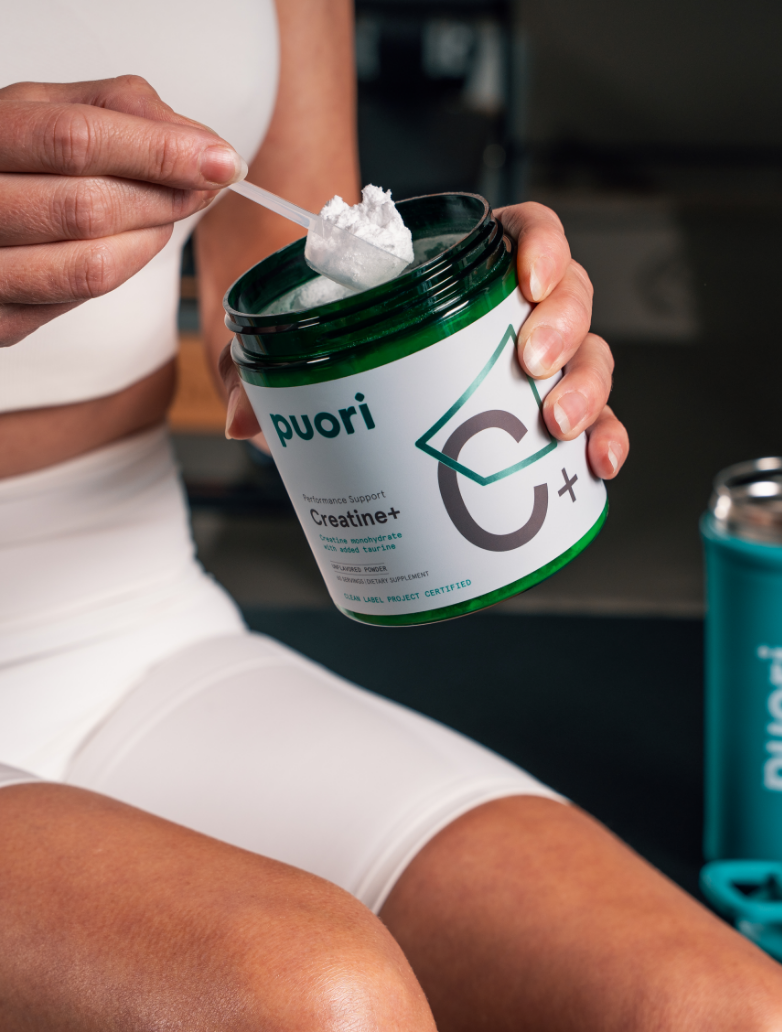
Follow the directions for your specific product. Standard creatine maintenance protocols commonly use around 3-5 g/day, and Creatine+ provides 5 g of creatine monohydrate per scoop for the US market (plus 400 mg of taurine). Don't increase your dose just because it's going into a protein shake instead of water.
2. Mix it with water or milk
Creatine can be added to a protein shake made with water, dairy milk, or plant-based milk. Milk doesn't make creatine ineffective, the main things it changes are calories, protein content, taste, texture, and individual digestive tolerance. If you care about what else is in your shake beyond the milk you choose, our Clean Promise page covers how we approach ingredient transparency across our products.
For a lighter, refreshing option, Puori's Cucumber Agua Fresca with Creatine+ recipe shows creatine can work outside a typical protein shake too.
3. Shake or blend thoroughly
Add creatine along with the protein powder and liquid, then shake or blend as usual. Some creatine may settle if the drink sits for a while. If residue remains, shake again before finishing, slightly undissolved creatine hasn't become ineffective, it just needs another shake.
4. Mix it close to when you plan to drink it
Creatine is generally stable as a dry powder, but once it is dissolved, its stability depends on the pH of the liquid, the temperature, and how long it sits. Over time, dissolved creatine gradually converts to creatinine, an inactive byproduct (Antonio et al., 2021). In practice this is a minor point: a shake that sits for a short while is not a problem, and there is no need to drink it within seconds of mixing. For simplicity, prepare your shake around when you plan to drink it rather than premixing it far in advance.
When should you take creatine and protein together?
There's no requirement to take them at exactly the same time. A protein shake can be a convenient vehicle for creatine after training, at breakfast, on rest days, or whenever it fits your routine.
Protein intake is mainly about meeting your overall daily protein needs and spacing it out reasonably. Creatine works by maintaining elevated muscle stores over time, so timing relative to your workout matters less than most people assume. If you only drink a protein shake on training days, remember that creatine is generally taken consistently, including rest days, and that its effectiveness doesn't depend on whatever else you're doing that day, including whether you're fasting.
Is there anything you shouldn't mix with creatine?
There's no need for a long list of foods and drinks to avoid. Creatine mixes fine with most common beverages and foods. A few practical points matter more than an exhaustive list:
- Very high caffeine intake may increase GI discomfort for some people
- Added sugar changes the calorie content of your shake but doesn't inherently "destroy" creatine.
- Avoid leaving creatine dissolved in liquid for unnecessarily long periods.
If you're taking medications or managing a medical condition, including blood-pressure medications like lisinopril, don't treat generic supplement content as a substitute for individualized advice. Check with your prescribing clinician or pharmacist rather than assuming a blanket yes or no.
FAQ
Is it better to take creatine with protein or separately?
Neither is clearly better. Both approaches deliver the same creatine benefits; taking them together is mainly a matter of convenience, not a performance advantage.
How much creatine should you put in a protein shake?
Use your normal daily serving, commonly 3-5 g/day for maintenance. Adding creatine to a shake doesn't change how much you need.
What's the best way to take creatine?
Consistently, once a day, in whatever liquid you find easiest to drink regularly. Daily consistency matters far more than the specific vehicle or timing you choose.
Why did I gain weight after taking creatine?
Early weight changes with creatine are typically related to water stored with muscle, not fat gain. See our guide: Does Creatine Make You Bloated? for a full explanation.
Should I take creatine and protein before or after a workout?
Either works. Creatine's benefit comes from maintained muscle stores over time rather than a narrow timing window, so pick whatever fits your routine consistently.
Does creatine make protein work better?
Not in a direct sense. They support different processes, muscle protein synthesis versus high-intensity energy availability, rather than amplifying each other.
Sources
- Green AL, Hultman E, Macdonald IA, Sewell DA, Greenhaff PL. Carbohydrate ingestion augments skeletal muscle creatine accumulation during creatine supplementation in humans. Am J Physiol. 1996;271(5 Pt 1):E821-826.
- Kreider RB, et al. International Society of Sports Nutrition position stand: safety and efficacy of creatine supplementation in exercise, sport, and medicine. J Int Soc Sports Nutr. 2017;14:18.
- Antonio J, et al. Common questions and misconceptions about creatine supplementation: what does the scientific evidence really show? J Int Soc Sports Nutr. 2021;18(1):13.
This article is for informational purposes only and is not a substitute for a varied diet or professional medical advice. If you have a medical condition or take medication, talk to your doctor before starting any supplement.
These statements have not been evaluated by the Food and Drug Administration. This product is not intended to diagnose, treat, cure, or prevent any disease.

Written by Alex
Editor, Puori


